

The “Research Ethics, Bioethics, Biolaw and Biopolitics” (EBE) (ISSN 3103-2648) series publishes essays, monographs, collective volumes, seminar proceedings and annotated documents on research ethics, bioethics, biolaw and biopolitics, which are the fields of investigation of the Interdepartmental Center for Research Ethics and Integrity of the CNR as well as the subjects of study and elaboration of institutional documents by the Research Ethics and Integrity Committee of the CNR.
A peer review process approves the content of the volumes in the series.
Directors
Cinzia Caporale, Elena Mancini, Ilja Richard Pavone
Scientific Committee
The Scientific Committee is composed of members of the CNR Research Ethics and Integrity Committee
Editorial Committee
Giorgia Adamo, Marco Annoni, Marco Arizza, Ludovica Durst, Andrea Grignolio Corsini, Silvia Scalzini, Giulia Sciolli, Roberta Martina Zagarella
Editorial Board
Tiziana Ciciotti (responsible), Paola Grisanti, Emiliano Liberatori
Graphic design of the volume
Marco Arizza (vol. 2)
Tiziana Ciciotti (vol. 3 and 4)
For more information: info@ethics.cnr.it
Explainability and Artificial Intelligence
Technological, Ethical, and Regulatory Perspectives
Research Ethics, Bioethics, Biolaw and Biopolitics 4, 2025
Edited by Ludovica Marinucci
From an interdisciplinary perspective, this anthology aims to explore the concept of “explainability” in Artificial Intelligence (AI), its ethical and legal implications, and the technological challenges it poses, fostering a dialogue among researchers from various disciplines (computer science, computational linguistics, logic, epistemology, ethics, bioethics, law, cognitive and social sciences). In particular, drawing on case studies, research projects, methodological approaches, and diverse scientific interests, the authors discuss whether and how the key requirement of explainability can be effectively met and implemented at the technological level, seeking not only to understand which specific obligations of explainability are taken into account by the community of researchers and experts in the field of AI, but also to predict the degree of ethical and legal compliance such systems may possess in the near future and the associated risks expected at the individual and societal levels. By presenting a variety of often conflicting research perspectives, the volume invites readers to consider ‘explainability’ as a multifaceted and layered concept that should be viewed not as a purely technical requirement but as a set of epistemic, ethical, and normative practices.
Published by Cnr Edizioni
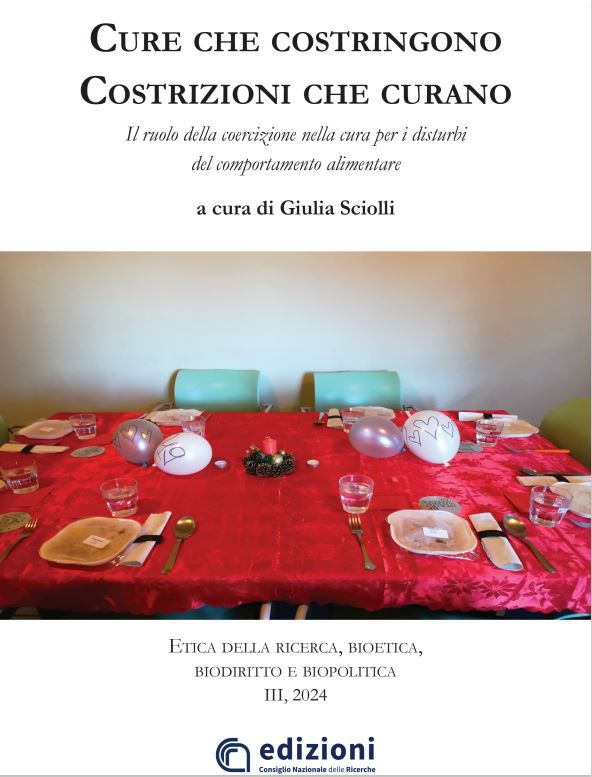
Coercive care, caring coercion: the role of coercion in eating disorder treatment
Edited by Giulia Sciolli
The idea for this interdisciplinary volume was born from the urgent need to examine the role of ‘coercion’ in the treatment of eating disorders, with particular attention to practical and ethical aspects. The volume aims to go beyond an analysis of coercion in its extreme form — compulsory treatment for the most severe cases of anorexia nervosa — and to consider also the everyday forms that coercion can take during the various phases of illness and treatment. The ultimate goal is to provide a tool to make the relationship between care and coercion less nebulous and less burdensome for all parties involved: patients, families, and healthcare professionals. Various aspects and degrees of coercion indeed characterize treatment pathways for all kinds of eating disorders, beyond the most extreme cases and even in instances of ‘voluntary’ admission to residential facilities. In all these cases too, the very ‘nature’ of eating disorders means that treatment requires daily care practices that are experienced by patients — and not only by them — as coercive.
The editor hopes that bringing together different voices from biomedicine, the psychological sciences, socio-cultural anthropology, philosophy, bioethics, and biolaw will help highlight the complexities of the relationship between care and coercion, not only in moments when immediate decisions must be taken on life or death issues, but also in the daily care practices that aim to prevent such extreme situations. The volume thus seeks to offer an inter- and transdisciplinary perspective, as is characteristic of the research tradition of the Interdepartmental Center for Research Ethics and Integrity at the CNR.
Published by Cnr Edizioni
ISBN (print edition) 978 88 8080 634 9
ISBN (digital edition) 978 88 8080 635 6
DOI 10.48220/eticabioeticabiodiritto-2024-3
After the pandemic. Notes for a new healthcare
Research Ethics, Bioethics, Biolaw and Biopolitics Series 2, 2022
Edited by Cinzia Caporale, Carla Collicelli, Ludovica Durst
The idea of the volume originates from the intention to collect a series of short texts for reflection and proposal on how we should proceed to generate renewed arrangements of the healthcare system in the Italian landscape as a result of the pandemic event. In the face of the transversal and pervasive shock represented by the global experience of the Covid-19 pandemic, which has affected all the fundamental dimensions of our collective existence, from relational and psychological dynamics to ethical, social, economic, administrative and political ones, the publication aims to provide an arena for rethinking what happened, offering an inter- and transdisciplinary perspective, as is proper to the research tradition of the CNR Interdepartmental Center for Research Ethics and Integrity. The editors’ desire is that it may represent a lucid testimony designed to stimulate debates and reconstruct issues experienced during the emergency, but also to offer significant insights that should not be lost in order to ethically and effectively guide the future of our healthcare and of the country.
Published by Cnr Edizioni

ISBN (print edition) 978 88 8080 634 9
ISBN (digital edition) 978 88 8080 635 6
DOI 10.48220/eticabioeticabiodiritto-2022-2

The Editorial Board is composed of Giorgia Adamo (Responsible), Tiziana Ciciotti, Paola Grisanti, Emiliano Liberatori and Elena Mancini
